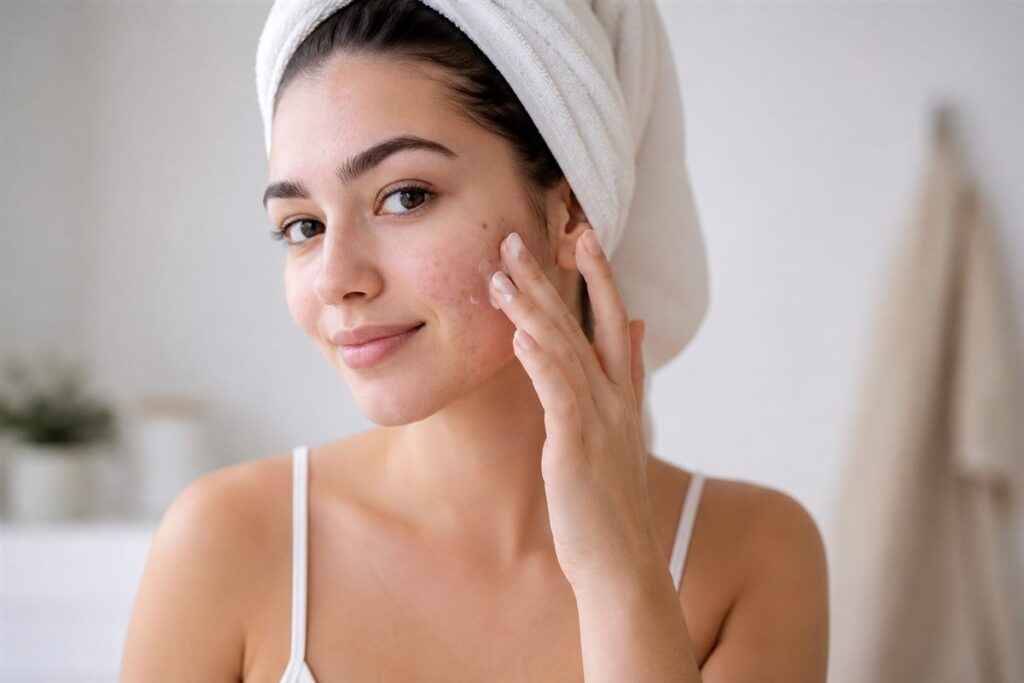
Acne is the most common skin condition in the world — affecting an estimated 650 million people at any given time, across every age group. Despite its prevalence, it remains one of the most misunderstood conditions in both consumer behavior and popular skincare advice. Many people make it worse with their treatment approach: over-cleansing, over-exfoliating, using too many products simultaneously, or reaching for harsh spot treatments that damage the skin barrier without addressing the root cause.
Understanding what acne actually is — the biological mechanisms behind it — immediately makes it clearer what works and why. It also explains why some widely promoted treatments are ineffective and others are transformative.
What causes acne: the four factors
Acne develops when four factors converge: excess sebum production, abnormal skin cell shedding (which clogs pores instead of being shed normally), the proliferation of the bacterium Cutibacterium acnes (formerly Propionibacterium acnes) within clogged pores, and inflammation. Different acne types reflect different dominant factors: comedonal acne (blackheads and whiteheads) primarily involves the first two; inflammatory acne (papules, pustules, nodules) involves all four.
Hormones and acne
Androgens (testosterone and its derivatives) are the primary hormonal driver of acne — they stimulate sebaceous glands to produce more sebum. This is why acne is common in adolescence (androgen surge at puberty) and why hormonal fluctuations continue to drive adult acne, particularly in women: breakouts commonly coincide with the menstrual cycle, pregnancy, or perimenopause. For hormonally driven acne that doesn’t respond to topical treatments, hormonal approaches (oral contraceptives, spironolactone, or other antiandrogens) can be highly effective when prescribed by a dermatologist.
Diet and acne
The relationship between diet and acne has been debated for decades. The current evidence is clearer than it was: high-glycemic foods (refined carbohydrates, sugar, white bread) increase insulin and IGF-1, which stimulate androgen production and sebum synthesis — several randomized controlled trials have demonstrated that low-glycemic diets reduce acne severity. Dairy — particularly skim milk — has been associated in multiple studies with acne, possibly through IGF-1 in milk and its hormonal content. These are not absolute rules, but they are meaningful associations worth testing through elimination and reintroduction.
The most effective topical treatments
Salicylic acid (BHA)
Salicylic acid is a beta hydroxy acid that is oil-soluble — meaning it can penetrate sebum-filled pores to exfoliate within the follicle, not just on the surface. At 0.5-2%, it dissolves the «glue» that holds dead skin cells together inside pores, preventing the formation of comedones and helping to clear existing ones. It also has mild anti-inflammatory properties. It is the first-line over-the-counter ingredient for comedonal and mild inflammatory acne. Use in cleansers, toners, or serums — daily at lower concentrations, or a few times weekly at higher concentrations to avoid over-drying.
Benzoyl peroxide
Benzoyl peroxide kills C. acnes bacteria by releasing oxygen into the follicle (anaerobic bacteria cannot survive in an oxygen-rich environment). At 2.5-5%, it is as effective as at 10% but significantly less irritating. It is one of the few topical acne treatments with evidence for reducing antibiotic resistance (unlike antibiotics used alone). Important: benzoyl peroxide bleaches fabric and hair — apply carefully and rinse before contact. Use as a spot treatment or as a wash-off treatment (cleansers with BP are more tolerable for daily use than leave-on products for many people).
Retinoids
Retinoids (adapalene, tretinoin) are the most comprehensive topical acne treatments because they address the root cause — abnormal follicular keratinization — rather than just the bacteria or inflammation. Adapalene 0.1% is available over the counter in many countries and is a first-line recommendation for acne by many dermatologists. It prevents new comedone formation, reduces inflammation, and — over months — significantly improves acne severity. It requires patience: a «purging» phase of increased breakouts is common in the first 4-8 weeks as the skin accelerates the turnover of existing clogged pores.
Conclusion: treat the cause, protect the barrier
The most common mistake in acne treatment is using too many active products simultaneously — a combination of benzoyl peroxide, salicylic acid, retinoid, and an exfoliating toner will strip the barrier faster than it can repair, causing a cycle of irritation and increased breakouts. Effective acne management uses the minimum number of targeted actives, supports the skin barrier with gentle cleansing and non-comedogenic moisturizers, and is consistent over months.
For moderate to severe acne — nodular or cystic lesions, widespread inflammatory acne, or any acne that is leaving scars — a dermatologist consultation is genuinely important. Prescription options (tretinoin, antibiotics, isotretinoin, hormonal treatments) are substantially more effective than anything available over the counter, and early treatment prevents the scarring that becomes permanent. Don’t wait until the damage is done.