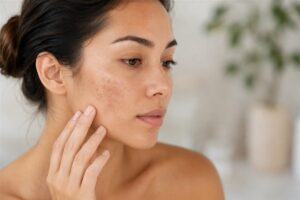
Sensitive skin affects approximately 60-70% of women and 50-60% of men in survey-based studies — making it one of the most commonly self-reported skin conditions globally. Yet «sensitive skin» is not a precise medical diagnosis. It is a description of a skin behavior: reactivity, easily triggered stinging, burning, redness, or tightness in response to products, environmental changes, temperature, or stress that wouldn’t bother someone with less reactive skin.
The mechanisms underlying skin sensitivity are varied — they can involve barrier dysfunction, nervous system hypersensitivity in the skin, immune system reactivity, or all three. Understanding which mechanisms are driving your skin’s sensitivity helps clarify both what to avoid and what to do.
The skin barrier: the foundation of sensitivity
The outermost layer of skin — the stratum corneum — functions as a physical and chemical barrier, controlling what gets in and what gets out. Its structure is often described as «bricks and mortar»: corneocytes (the bricks) held together by a lipid matrix rich in ceramides, cholesterol, and fatty acids (the mortar). When this barrier is intact, irritants and allergens are blocked, moisture is retained, and the skin remains calm and comfortable.
What damages the barrier
A compromised or «leaky» barrier is at the root of most cases of skin sensitivity. Common causes: over-cleansing with harsh surfactants (sodium lauryl sulfate is particularly disruptive), over-exfoliating (too many acids, too frequently), fragrance and essential oils (which are among the most common contact sensitizers), long hot showers (which wash away protective lipids), low humidity environments, and — increasingly recognized — microbiome disruption from antimicrobial ingredients and antibiotics. Once the barrier is compromised, sensitizers penetrate more easily, triggering inflammatory responses that cause the stinging, redness, and reactive cycles that characterize sensitive skin.
Barrier repair: the priority
The most effective approach to sensitive skin is not to chase every symptom with targeted treatments — it is to first repair the barrier. This means stripping the routine back to the minimum: a fragrance-free, gentle cleanser; a ceramide-rich, fragrance-free moisturizer; and SPF. Nothing else. Give the barrier 2-4 weeks to recover. Most people find their reactivity improves dramatically with this approach — because many cases of «sensitive skin» are actually acquired barrier disruption from an overcomplicated routine, not intrinsic sensitivity.
Ingredients to avoid and ingredients that help
What to avoid
Fragrance (both synthetic and natural / «botanical») is the number one cause of cosmetic contact dermatitis. It appears in ingredient lists as «fragrance,» «parfum,» «essential oils,» or as specific fragrant ingredients (linalool, limonene, geraniol, etc.). For sensitive skin, fragrance-free is non-negotiable — not «unscented» (which may contain masking fragrances) but fragrance-free. Also avoid: alcohol denat. (drying and irritating), sodium lauryl sulfate, retinoids and AHAs until the barrier is repaired, and waterproof or long-wear products with harsh removers.
What helps: calming and barrier-supporting ingredients
Ceramides (ceramide NP, AP, EOP) directly replenish the lipid matrix of the stratum corneum. Products containing a combination of ceramides, cholesterol, and fatty acids (in the ratio found in healthy skin: approximately 3:1:1) show the best barrier repair outcomes in clinical studies. Niacinamide at 2-5% strengthens the barrier, reduces redness, and has excellent tolerability. Centella asiatica (cica) extracts (containing asiaticoside, madecassoside, and asiatic acid) have significant anti-inflammatory and wound-healing properties and have become one of the most popular calming ingredients in Korean skincare. Allantoin and panthenol (vitamin B5) both support healing and comfort. Colloidal oatmeal has FDA-approved efficacy for itch relief and dermatitis soothing.
Conclusion: less is more, and barrier is everything
Managing sensitive skin successfully requires a mindset shift: away from treating every symptom with a new product, and toward creating the stable, minimally disrupted environment in which the skin can repair itself. The paradox of sensitive skin is that the more products people add trying to fix it, the more disrupted the barrier becomes — and the more sensitive the skin gets. The solution is almost always to use fewer products, simpler formulations, and to prioritize barrier repair above everything else.
Once the barrier is stable and reactivity has reduced, you may gradually reintroduce carefully chosen actives — but always one at a time, patch tested, and with a waiting period between introductions. Your skin will tell you clearly what it can and cannot tolerate. Listen to it.