
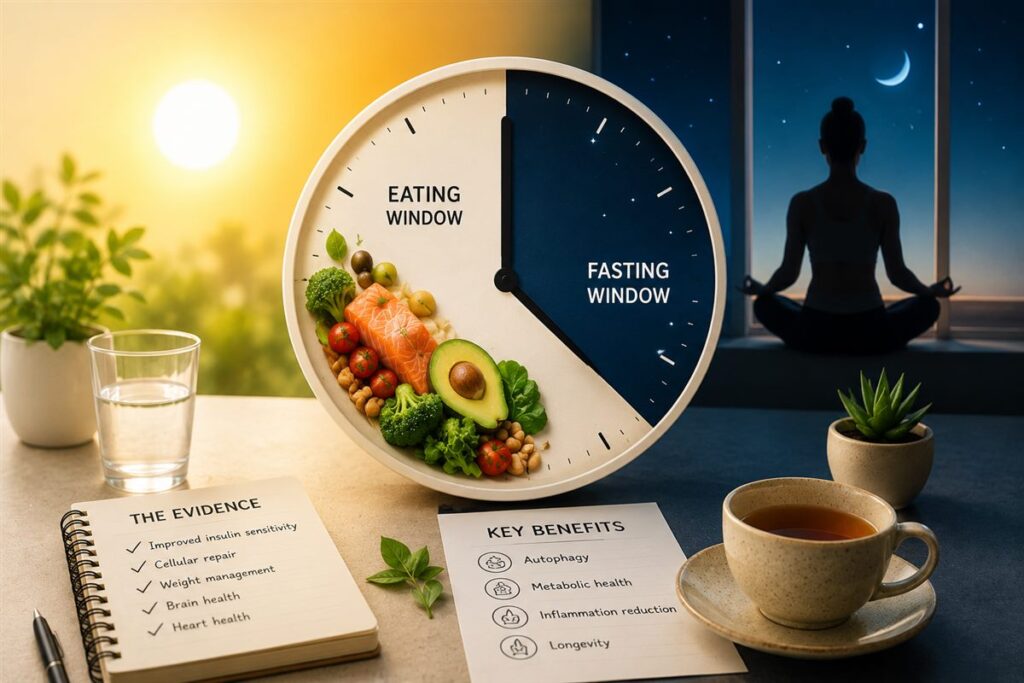
Intermittent fasting (IF) became one of the most-discussed dietary approaches of the 2010s and 2020s — promoted as a metabolic reset, a path to effortless weight loss, and a trigger for cellular autophagy. The research is genuinely interesting and in some ways supportive. But the popular narrative has significantly outpaced the evidence, particularly around claims of metabolic benefits beyond those achievable through equivalent caloric restriction. A clear-eyed look at what the evidence shows and doesn’t show is useful for anyone considering whether IF is worth trying.
What intermittent fasting is — and what it isn’t
Intermittent fasting is a structured eating pattern characterized by alternating periods of eating and fasting. The most common protocols: 16:8 (eating within an 8-hour window, typically noon to 8pm, and fasting for 16 hours including sleep); 5:2 (eating normally five days per week, and restricting to approximately 500-600 calories on two non-consecutive days); OMAD (one meal a day — an extreme form of 16:8 with a 1-2 hour eating window); and alternate day fasting (alternating between normal eating days and very low-calorie days). These are not diets in the sense of prescribing what to eat — they specify when to eat, leaving food choices to the individual.
The caloric restriction question
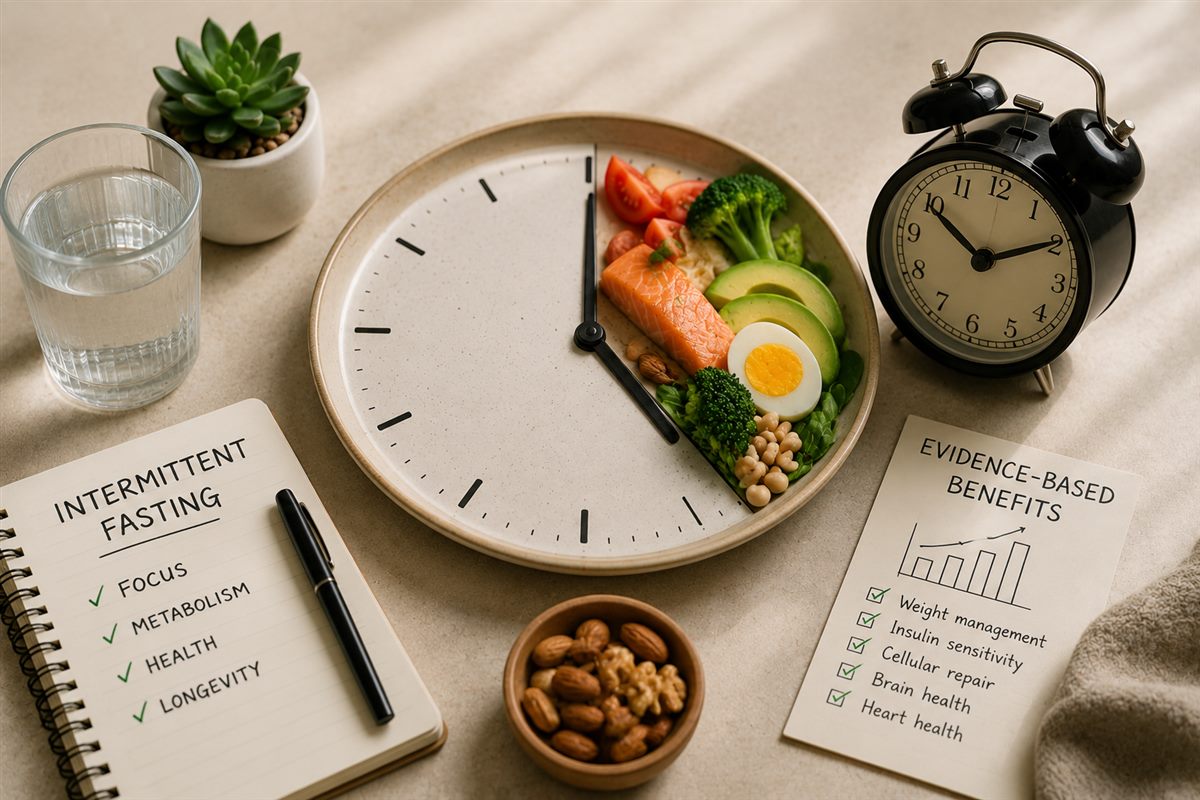
The central debate in IF research is whether the fasting periods themselves have metabolic benefits beyond the caloric restriction they typically produce — or whether the benefits are simply the result of eating less. Most people who adopt 16:8 naturally eat fewer calories because they’ve eliminated late-night eating and breakfast (typically high-calorie meals or snacks for many people). When studies carefully control for caloric intake — giving IF and non-IF groups the same number of calories — most metabolic differences between the groups disappear or become modest. A 2020 randomized controlled trial in the New England Journal of Medicine (Lowe et al.) found that 16:8 IF without explicit caloric restriction produced no more weight loss than consistent caloric restriction over 12 weeks.
Where IF genuinely shows promise
Circadian-aligned eating
One finding that appears robust and genuinely interesting regardless of caloric intake: eating aligned with circadian rhythms (front-loading calories earlier in the day, not eating late at night) appears to have metabolic benefits independent of total calories. Studies on time-restricted eating where the eating window is in the morning and early afternoon (8am-4pm) rather than the conventional noon-8pm window show better insulin sensitivity, blood pressure, and markers of metabolic health compared to equivalent caloric intake in a later window. The mechanism involves circadian regulation of insulin secretion, glucose tolerance, and digestive enzyme activity — all of which peak in the morning and decline toward evening. This is a nuanced finding that popular IF promotion often misses: the time of the eating window matters as much as its duration.
Autophagy and longevity claims
The Nobel Prize-winning research on autophagy (Yoshinori Ohsumi, 2016) identified fasting as a trigger for cellular autophagy — the process by which cells break down and recycle damaged components. This is a real and important biological process. The leap from this finding to practical health claims for 16-hour fasts in humans is larger than popular IF promotion suggests. Most autophagy research was conducted in yeast and rodents under prolonged fasting conditions significantly more extreme than typical IF protocols. How much autophagy is triggered by a 16-hour fast in humans, how clinically significant this is, and whether it meaningfully affects longevity in healthy adults, is genuinely unknown.
Conclusion: a useful tool for some, not a metabolic magic trick
Intermittent fasting is a legitimately useful eating structure for people who find it easier to manage caloric intake by restricting their eating window than by consciously portioning meals. If skipping breakfast and not eating after 7pm helps you eat less overall without hunger or obsession, IF is a practical approach with good adherence. The evidence is solid that it produces weight loss and metabolic improvements comparable to equivalent continuous caloric restriction — which is meaningful.
It is not, however, a metabolic intervention that produces benefits beyond what caloric reduction achieves, and the more extreme claims around autophagy and longevity in humans remain ahead of the evidence. People with a history of disordered eating, those who are pregnant, adolescents, and people with type 1 diabetes should approach IF with caution or avoid it. The best eating pattern is the one you can sustain — and for many people, that isn’t one that creates significant food restriction windows.