
Hyaluronic acid has become one of the most ubiquitous ingredients in skincare — it appears in serums, moisturizers, sheet masks, eye creams, and even some cleansers. The marketing around it is enthusiastic to the point of hyperbole: «plumps,» «fills,» «erases lines,» «deep hydration.» Some of this is true. Some of it significantly overstates what topical HA can actually do.
Understanding the science behind hyaluronic acid — what it genuinely does, how to use it correctly (there is a right and wrong way), and what its limitations are — lets you make it a genuinely useful part of your routine rather than an expensive bottle of hype.
What hyaluronic acid is and does
Hyaluronic acid (HA) is a glycosaminoglycan — a type of sugar molecule — that occurs naturally in the body, with the highest concentrations in the skin, connective tissue, and eyes. Its primary biological function is to bind and retain water: a single gram of HA can hold up to 6 liters of water. In the skin, HA is a critical component of the extracellular matrix — the structural scaffold between skin cells — where it maintains hydration, supports elasticity, and facilitates cell communication.

The natural decline of HA with age
The skin naturally synthesizes hyaluronic acid, but production declines significantly with age — by the time we reach our 40s and 50s, HA content in the skin can be half of what it was in youth. This decline contributes directly to the loss of plumpness, skin volume, and hydration that characterizes aging skin. UV exposure and smoking accelerate HA degradation. This is one reason injectable HA fillers (like Juvederm and Restylane) are so effective at restoring volume — they directly replace what has been lost.
What topical HA does (and doesn’t do)
Topical hyaluronic acid is a humectant — it draws water to the skin’s surface. Applied to damp skin, it attracts moisture from the environment and from slightly deeper skin layers, temporarily plumping the surface and reducing the appearance of fine lines caused by dehydration. This effect is real and visible, but it is primarily superficial and temporary — topical HA does not penetrate to the dermis in significant amounts, and it does not rebuild or replace the HA framework that degrades with aging.
The molecular weight of HA matters considerably. High-molecular-weight HA (which forms a hydrating film on the skin’s surface) provides visible plumping but minimal penetration. Low-molecular-weight HA penetrates slightly deeper into the epidermis. Some formulations use a combination of both for surface and slightly deeper effects. Sodium hyaluronate (the salt form of HA) is smaller and penetrates better than pure HA.
How to use hyaluronic acid correctly
The application method for HA serums is not intuitive, and using it incorrectly can actually worsen dryness — particularly in dry climates or during winter.
Apply to damp skin — always
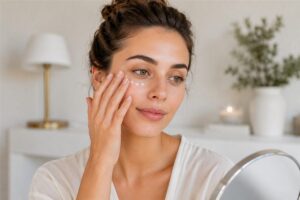
Hyaluronic acid needs water to attract. If applied to completely dry skin in a low-humidity environment, it will draw water from the deeper layers of your skin rather than from the atmosphere — potentially increasing transepidermal water loss. The correct method: apply your HA serum immediately after cleansing while skin is still slightly damp (within 30-60 seconds), or mist the face with water first if your skin has fully dried. Follow immediately with a moisturizer or cream to seal the water in — HA without an occlusive on top can evaporate.
Layer correctly
HA serums are typically applied before heavier moisturizers. The general layering rule in skincare: thinnest to thickest, or water-based before oil-based. HA serum → lightweight moisturizer or cream → sunscreen (morning). HA serum → heavier night cream (evening). If using retinol, HA can be layered either over or under it — it helps buffer potential irritation from retinoids when applied first.
Conclusion: a genuinely useful ingredient when used correctly
Hyaluronic acid is not a miracle ingredient — it does not rebuild collagen, fill deep wrinkles, or reverse aging. But it is a genuinely effective humectant that provides real, visible hydration when used correctly: on damp skin, followed by a moisturizer to lock it in. For anyone dealing with dehydration, surface dryness, or the wish for a more plump appearance, it is an excellent addition to the routine.
Its safety profile is exceptional — it is well tolerated by virtually all skin types including sensitive and acne-prone skin. It is one of the few skincare ingredients that the industry’s enthusiasm for is actually matched, at least partially, by the science.