
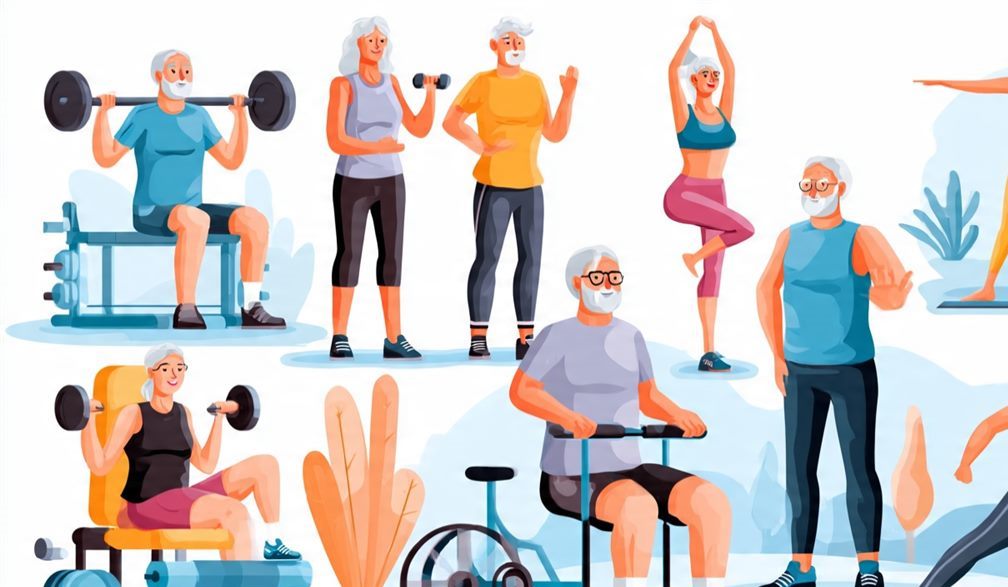
The narrative that fitness declines are an inevitable consequence of aging — and therefore exercise becomes less relevant — is physiologically backwards. The age-related declines in muscle mass, bone density, aerobic capacity, balance, and metabolic function that people attribute to aging are substantially driven by physical inactivity rather than the passage of time alone. Exercise not only slows these declines but partially reverses them at any age. The physiology does change with age in ways that require training adjustments — but the importance of exercise increases with age, not decreases.
Key physiological changes with aging and why they matter
Sarcopenia (muscle loss): beginning around age 30-35, adults lose approximately 3-8% of muscle mass per decade, accelerating to 10-15% per decade after 60 in inactive individuals. Loss of muscle mass reduces metabolic rate, functional capacity (ability to climb stairs, carry loads, rise from chairs), glucose regulation, and is a primary driver of disability in older adults. Resistance training is the most effective intervention. Osteopenia/osteoporosis: bone density peaks in the mid-20s and declines thereafter, accelerating after menopause in women (estrogen is anabolic for bone). Impact exercise and resistance training apply mechanical stress that maintains and can increase bone mineral density. VO2max decline: maximal aerobic capacity declines approximately 10% per decade after age 25 in sedentary individuals; this rate is approximately halved in regularly active individuals, and regular high-intensity aerobic training significantly attenuates the decline. Balance and fall risk: proprioception and vestibular function decline with age, increasing fall risk (falls are the leading cause of injury-related death in adults over 65). Balance training and leg strength are highly protective.

Anabolic resistance: the protein and training implication
An important physiological change relevant to exercise response: older muscle tissue shows «anabolic resistance» — a reduced sensitivity to the muscle protein synthesis signals triggered by both exercise and dietary protein. The practical implications: older adults need more protein per meal to achieve the same muscle protein synthesis response as younger adults (the leucine threshold is effectively higher); they benefit from slightly higher total protein intake (1.2-1.6g/kg/day rather than the minimum RDA); and they may need more training volume and frequency to achieve equivalent muscle maintenance compared to younger adults. This is not a reason to reduce training in older age — it is a reason to ensure training adequacy.
Adapting training for midlife and beyond
Training modifications that matter after 40
Recovery time: recovery from intense training lengthens with age — the same workout that needed 48 hours to recover from at 25 may need 72 hours at 50. Adjusting for this with more rest between hard sessions prevents chronic fatigue without reducing total training stimulus. Mobility and warm-up: connective tissue loses elasticity and hydration with age; a longer, more thorough warm-up becomes increasingly important for injury prevention and movement quality. Impact considerations: while impact exercise (running, jumping) is valuable for bone density, accumulated joint wear means that training volume and impact should be managed carefully — complementing running with lower-impact activities (swimming, cycling, rowing) reduces cumulative joint stress while maintaining fitness. Prioritize strength and balance: if time is limited after 50, strength training and balance work have higher health ROI than cardiovascular exercise alone — they address sarcopenia, osteopenia, and fall prevention simultaneously.
It is never too late to start
One of the most consistent and encouraging findings in exercise and aging research: the response to training is robust at any age. 70, 80, and even 90-year-old adults in randomized controlled trials show meaningful increases in muscle mass, strength, bone density, aerobic capacity, and functional mobility from training programs. A landmark study by Fiatarone et al. in the New England Journal of Medicine (1990) showed that 10 weeks of resistance training in frail nursing home residents aged 86-96 produced 174% average strength gains and measurable improvements in walking speed and balance. Frailty is reversible. The functional decline considered inevitable aging is substantially preventable — and partially reversible — through exercise at any age at which it is begun.
Conclusion: after 40, train consistently and prioritize strength
The most valuable shift in training philosophy after 40: from performance optimization toward longevity and functional preservation. This means prioritizing strength training (for muscle and bone), aerobic fitness (for cardiovascular and cognitive health), balance training (for fall prevention), and mobility work (for joint function) — with training load adjusted for the longer recovery windows that come with age.
The evidence is unambiguous: physically active older adults have dramatically better health outcomes — lower chronic disease incidence, better cognitive function, preserved mobility, and significantly longer healthy life expectancy — than inactive contemporaries. The age at which you start doesn’t matter. Starting matters.