
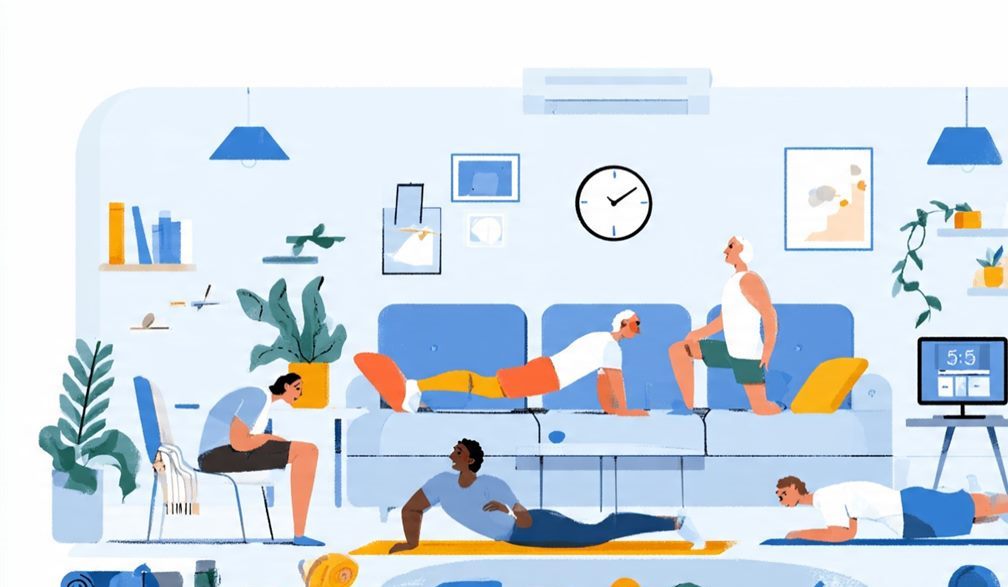
The gym is a convenience, not a requirement. Bodyweight training has a centuries-long track record — gymnasts, martial artists, and calisthenics practitioners build extraordinary levels of strength, endurance, and body control with nothing more than their own bodyweight and a floor. For most recreational fitness goals — building baseline strength, improving cardiovascular fitness, maintaining or improving body composition — well-designed bodyweight training is a fully adequate solution. Understanding its strengths, its limitations, and how to apply progressive overload without equipment turns home workouts from a stopgap into a sustainable primary training method.
What bodyweight training can and cannot do
Strengths: Highly effective for lower body strength (squats, lunges, single-leg variations are challenging at any level), core development, upper body pushing strength (push-up progressions are a full upper body push program on their own), cardiovascular conditioning (circuits, plyometrics, high-rep training), and mobility. Requires zero equipment, zero gym membership, and minimal space — the lowest friction possible for training. Limitations: Developing maximal lower body strength beyond a certain point requires external load — single-leg squats (pistol squats) and their progressions allow significant bodyweight lower body strength development, but eventually a barbell is more efficient. Upper body pulling strength is a common limitation — pull-ups and rows require either a pull-up bar, a table edge, or rings. Back training specifically is harder to access without equipment. Maximal strength and power development for advanced athletes typically requires external load eventually.
Progressive overload without weights
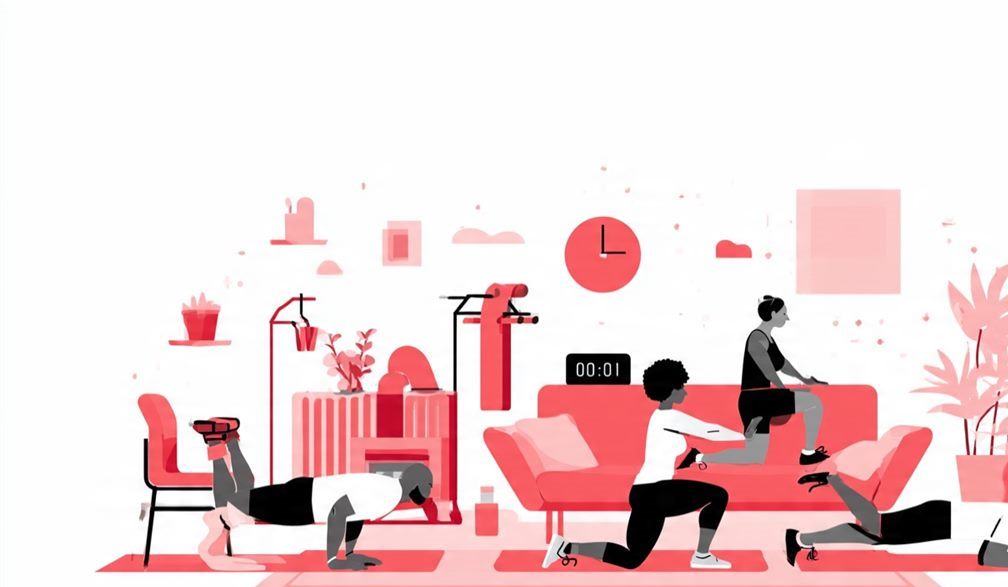
The most important principle for home training: progressive overload must still be applied. The body adapts to current demands and stops improving without increasing challenge. Without weights, progression uses: Exercise progression — moving to harder variations of the same movement pattern (push-up → incline push-up → flat push-up → close-grip push-up → decline push-up → archer push-up → one-arm push-up); Tempo manipulation — slowing the eccentric (lowering) phase of movements dramatically increases difficulty and time under tension (a 5-second lowering phase on a squat is significantly harder than a standard pace); Reducing rest — shorter rest periods increase cardiovascular demand and metabolic stress; Volume increases — adding sets and repetitions when current volume is comfortable; Plyometric progression — adding jumping or explosive variations for power development.
A practical home workout framework
The fundamental movement pattern approach
Covering the six fundamental movement patterns (squat, hinge, push, press, horizontal pull, vertical pull) with bodyweight options: Squat: air squat, goblet squat hold, split squat, Bulgarian split squat, pistol squat progression. Hinge: glute bridge, single-leg glute bridge, hip thrust, Romanian deadlift (with light weights if available), single-leg RDL. Horizontal push: push-up and all progressions listed above. Vertical push: pike push-up, decline push-up, handstand wall holds. Horizontal pull: table/desk row (lie under a sturdy table, pull chest to table edge), resistance band row, suspension row. Vertical pull: pull-up bar (inexpensive, fits in a doorframe), assisted pull-up variations, or resistance band lat pulldown. The one minimal investment worth making: a doorframe pull-up bar. It costs less than one gym visit and unlocks horizontal and vertical pulling exercises that are difficult to replicate otherwise.
Sample full-body home workout
A practical 30-minute bodyweight session: Dynamic warm-up (5 min): hip circles, leg swings, thoracic rotations, arm circles. Circuit A (3 rounds, 45s work / 15s rest): push-ups, air squats, glute bridges, mountain climbers. Circuit B (3 rounds): pike push-ups (or decline push-ups), split squats (each leg), single-leg glute bridges, plank hold. Finisher (optional, 5 min): Tabata-style burpees or jump squats. Cool-down (5 min): static stretches for hip flexors, hamstrings, chest, and shoulders. This structure addresses pushing, lower body, and core patterns. Adding a pull-up bar and a resistance band to this framework completes the pulling pattern deficiency.
Conclusion: zero equipment, zero excuses — if the program is right
Bodyweight training is a genuinely effective training method with a clear progression pathway from beginner to advanced. The minimum investment — a doorframe pull-up bar — unlocks the full spectrum of fundamental movement patterns. With consistent progressive overload, three sessions per week of 30-40 minutes is sufficient to build meaningful strength, maintain cardiovascular fitness, and improve body composition.
The caveat: home workouts require more self-discipline than gym training (no social environment, no equipment prompting the next exercise, no trainer). Addressing this with scheduled sessions treated as non-negotiable appointments, and pre-planned workouts that require no in-the-moment decision-making, significantly improves adherence.