
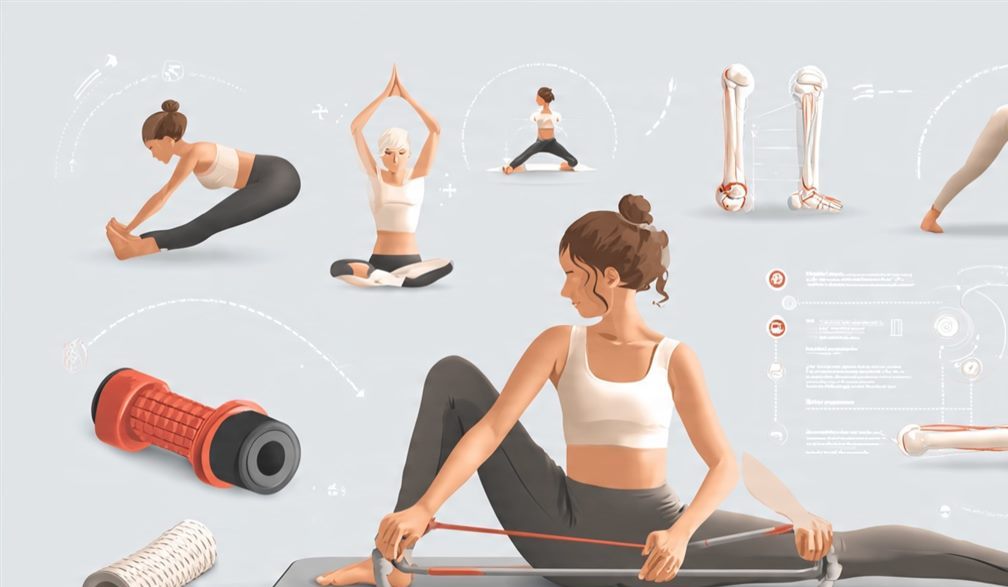
Flexibility and mobility are the most consistently neglected components of fitness — relegated to brief, obligatory stretching at the end of a workout, if they’re addressed at all. This is a significant oversight. Declining joint mobility with age — typically beginning in the 30s and accelerating through midlife — underlies much of the functional limitation, pain, and injury susceptibility that people attribute to inevitable aging. Maintaining adequate flexibility and mobility throughout adult life substantially reduces this trajectory, and both respond well to training at any age.
Flexibility vs. mobility — an important distinction
Flexibility refers to the passive range of motion of a muscle — how far a muscle can lengthen when an external force (your body weight, gravity, or a partner) is applied. The classic hamstring stretch tests flexibility. Mobility refers to active range of motion — how far a joint can move through its full range under the control of the muscles that cross it. A deep squat tests hip and ankle mobility. The distinction matters: you can have high passive flexibility (you can be pushed into a split passively) without the strength and control to achieve that range actively — and passive flexibility without active control is associated with higher injury risk, not lower. Functional movement requires both: adequate tissue length (flexibility) and the strength to control that range (mobility).

Static stretching: when it helps and when it doesn’t
Static stretching (holding a stretched position for 20-60 seconds) improves passive flexibility over time and is the most accessible flexibility training tool. Key evidence: Before exercise: static stretching immediately before high-intensity or strength training mildly reduces force production and power output — it reduces neural activation in the stretched muscles. Reserve static stretching for post-workout or dedicated flexibility sessions, not immediately before heavy lifting or sprint training. After exercise: post-workout static stretching improves flexibility effectively and takes advantage of elevated tissue temperature. Dedicated sessions: 10-20 minutes of static stretching daily produces the most consistent flexibility improvements. Each stretch held for 30-60 seconds, 2-3 repetitions per muscle group.
Mobility training: developing active range of motion
Dynamic warm-up as mobility work
Dynamic mobility drills (controlled movements through range of motion — leg swings, hip circles, thoracic rotations, ankle circles) are appropriate before exercise, unlike static stretching. They prepare joints for movement without the strength-reducing effects of prolonged static stretching. A 5-10 minute dynamic mobility warm-up before strength training or sports reduces injury risk by increasing joint lubrication (synovial fluid distribution), raising local tissue temperature, and activating the muscles that control joint movement. Standard dynamic warm-up: hip circles, leg swings (front-to-back and side-to-side), thoracic spinal rotation, ankle circles, shoulder circles, controlled squats.
Targeted mobility work for common restriction areas
Sedentary work and prolonged sitting predictably create mobility restrictions in specific areas that affect most adults: Hip flexors: chronically shortened from prolonged sitting — restricts hip extension (needed for running gait and proper squat), causes anterior pelvic tilt and low back strain. Address with: couch stretch, hip flexor lunge stretch, 90/90 hip stretch. Thoracic spine: thoracic extension mobility decreases with hunched posture and desk work — restricts overhead shoulder range and causes compensatory lumbar strain. Address with: thoracic extension over foam roller, cat-cow, book opener rotations. Ankles: limited ankle dorsiflexion (ankle mobility into squat) produces compensatory forward lean in squats, increasing knee and lower back stress. Address with: ankle circles, knee-to-wall stretch, calf stretching.
Conclusion: 10 minutes of mobility work daily prevents decades of restriction
The most effective approach for most people: a 5-10 minute dynamic mobility warm-up before training sessions (targeting hips, thoracic spine, and ankles specifically); post-workout static stretching for the major muscle groups trained; and a dedicated 10-15 minute daily mobility practice addressing the most common restriction areas (hip flexors, thoracic spine, ankles) if flexibility is a specific concern.
Flexibility and mobility improve consistently with regular practice — even adults in their 50s and 60s who begin a consistent mobility practice show meaningful improvements within 8-12 weeks. The earlier these practices are established as habits, the more functional movement is preserved through each subsequent decade.