
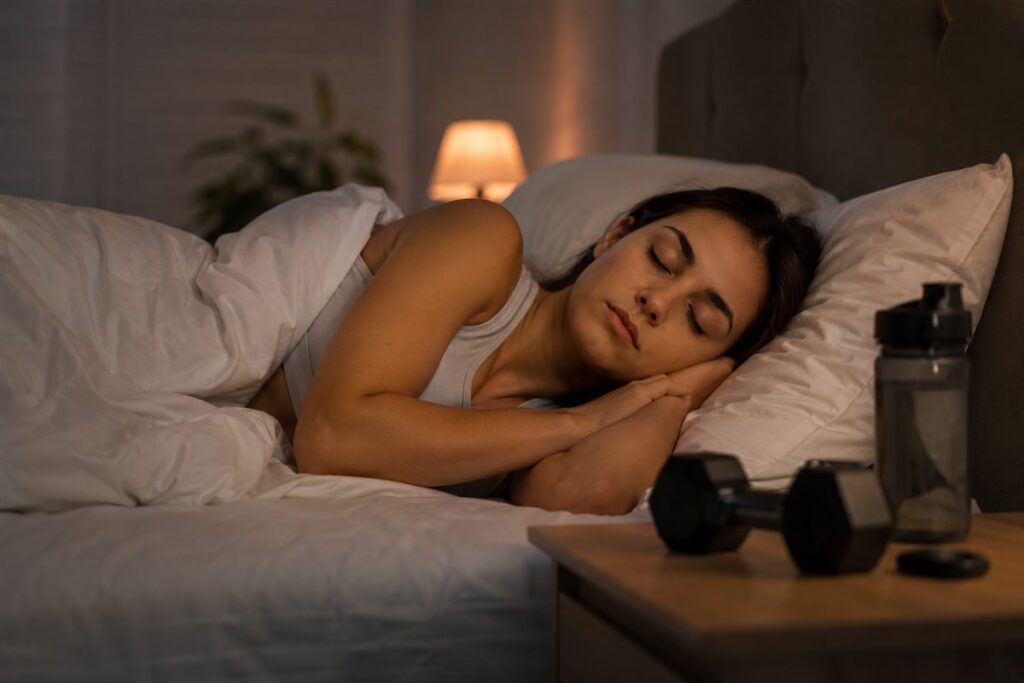
The relationship between sleep and exercise runs in both directions with roughly equal force: regular physical activity consistently improves sleep quality, duration, and architecture; and adequate sleep is essential for virtually every physiological adaptation that exercise produces. This bidirectionality means that neglecting one undermines the other — and that optimizing both creates a self-reinforcing upward spiral for health and performance.
How exercise improves sleep
The mechanisms through which exercise improves sleep are multiple and well-characterized. Adenosine accumulation: physical activity accelerates adenosine production — the same sleep-pressure molecule that accumulates throughout the waking day. Exercise increases adenosine and related metabolites, deepening the homeostatic sleep pressure that drives slow-wave (deep NREM) sleep. This is why physically active people consistently report deeper, more restorative sleep. Core temperature: vigorous exercise raises core body temperature significantly; in the hours following exercise, the body’s thermoregulatory cooling response produces the temperature drop that facilitates sleep onset — a similar mechanism to the warm bath effect. Anxiety and cortisol regulation: regular moderate-intensity exercise is among the most effective interventions for reducing trait anxiety and normalizing the HPA axis cortisol response. Since hyperarousal (elevated cortisol, sympathetic activation) is a primary driver of insomnia, exercise addresses a root cause. Circadian amplitude: physically active people show stronger circadian rhythms — higher amplitude cortisol peaks, more pronounced temperature rhythms, stronger melatonin secretion — which correspond to better sleep quality and timing.

What the research shows on exercise type and sleep
Meta-analyses of exercise and sleep consistently find beneficial effects across multiple sleep parameters. A 2017 meta-analysis (Kredlow et al.) covering 66 studies found that regular exercise significantly improved: total sleep time, sleep efficiency (time asleep / time in bed), sleep onset latency, time in slow-wave sleep, and subjective sleep quality. The effect sizes were clinically meaningful (0.35–0.55 for most outcomes) — comparable to the effects of sleep hygiene interventions. Both aerobic exercise (consistent, moderate-intensity — 150 min/week WHO guideline level) and resistance training produce sleep benefits, through partially different mechanisms. Resistance training specifically increases slow-wave sleep amplitude and growth hormone secretion during deep NREM. Yoga and tai chi show benefits particularly in older adults and in people with sleep disturbance, likely through combined physical, thermal, and anxiety-reduction mechanisms.
How poor sleep undermines exercise adaptations
Muscle building and recovery
The vast majority of muscle protein synthesis and growth hormone secretion occurs during sleep — specifically during deep NREM (slow-wave) sleep in the first half of the night. Sleep restriction (less than 6 hours) significantly reduces growth hormone pulsatility, blunts muscle protein synthesis, and increases muscle protein breakdown via elevated cortisol. A landmark study by Nedeltcheva et al. (2010) found that individuals on a calorie-restricted diet who slept 5.5 hours lost 60% less muscle mass compared to those sleeping 8.5 hours — same caloric deficit, dramatically different body composition outcomes. For anyone engaged in resistance training, sleep is not merely recovery time: it is the primary window in which adaptation occurs.
Performance, injury risk, and motivation
Sleep deprivation produces measurable decrements in virtually every performance parameter: reaction time, cardiovascular output, lactate threshold, maximal strength, accuracy in skill-based sports, and perceived exertion (same workload feels harder after poor sleep). Injury risk increases substantially — multiple studies in athlete populations show 1.7–3× increased injury rates with chronic sleep restriction. Motivationally, poor sleep increases perceived effort for exercise and decreases reward sensitivity, making workouts feel harder and less rewarding — a pattern that progressively erodes the exercise habit.
Exercise timing: what the evidence actually says
The long-held recommendation to avoid exercise within 3–4 hours of sleep has been substantially revised by more recent research. A 2019 meta-analysis (Stutz et al.) found that vigorous exercise ending up to 1 hour before bed does not significantly impair sleep in most people. Individual variation is considerable: some people find late evening exercise invigorating and sleep-disrupting; others sleep better after evening workouts due to the temperature-drop and adenosine effects. The practical guidance: experiment individually. If evening exercise does not impair your sleep, there is no reason to avoid it. If you notice delayed sleep onset after late workouts, shift exercise earlier. Morning and afternoon exercise consistently shows the clearest benefit with the lowest risk of disruption.
Conclusion: exercise is sleep medicine; sleep is training infrastructure
Regular physical activity — even 30 minutes of moderate-intensity exercise most days — produces sleep improvements comparable to sleep hygiene interventions. It is one of the highest-leverage actions for people who struggle with sleep quality. For athletes and people training for performance or body composition, sleep is not optional: it is the primary physiological window in which training adaptations are made. Prioritizing 7–9 hours is as important as any training variable.
The most important single habit change for someone who both exercises poorly and sleeps poorly: start consistent moderate exercise. Improving exercise almost always improves sleep, and improving sleep almost always improves exercise performance and motivation — the two systems amplify each other.