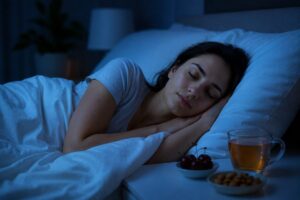

Sleep hygiene refers to the behavioral and environmental practices that support consistent, quality sleep. Unlike sleep medications (which can improve short-term sleep but carry dependency risks and don’t address root causes) or supplements (whose effects are modest), sleep hygiene changes address the actual physiological and behavioral drivers of poor sleep. The practices below are ranked roughly by evidence strength — not all sleep hygiene recommendations are equally supported.
Tier 1: Highest-evidence sleep hygiene practices
Consistent wake time
The most powerful single sleep intervention is maintaining a consistent wake time, including on weekends. The circadian clock is anchored primarily by the timing of light exposure and wake time — consistently waking at the same time each day strengthens the circadian signal and makes sleep initiation at a consistent bedtime progressively easier. Variable wake times (sleeping in on weekends) create the equivalent of weekly transatlantic jet lag, weakening the circadian signal and producing «social jet lag» — difficulty falling asleep Sunday night and functioning Monday morning. This is the one recommendation that sleep medicine consistently prioritizes above all others, including bedtime consistency.

Morning light exposure
Light is the primary zeitgeber (time-giver) for the human circadian clock. Exposure to bright natural light (ideally outdoor) within the first hour after waking suppresses residual melatonin, advances the circadian clock, and sets the timing for melatonin secretion approximately 14-16 hours later — determining when you feel sleepy at night. In the absence of morning light (indoor living, dark seasons), the circadian clock drifts and sleep quality and timing both suffer. Practice: 10-20 minutes of outdoor light exposure within the first hour of waking. Cloudy outdoor light (thousands of lux) is dramatically more effective than indoor lighting (typically 100-500 lux). Light therapy boxes at 10,000 lux are an effective substitute for darker seasons or climates.
Temperature: cool room, warm bath
Core body temperature must drop 1-2°C to initiate sleep. This thermoregulatory process is one of the most consistent physiological signals of the sleep onset mechanism. Supporting it: sleep in a cool room (16-19°C / 60-67°F for most people); take a warm bath or shower 1-2 hours before bed (the body’s subsequent heat dissipation after the bath produces a significant temperature drop and consistent evidence for faster sleep onset and improved deep sleep). Hot baths and showers, counterintuitively, improve sleep through the temperature drop that follows — not through relaxation alone.
Tier 2: Well-supported sleep hygiene practices
Caffeine cutoff — earlier than most people realize
Caffeine blocks adenosine receptors — adenosine is the sleep pressure signal that accumulates throughout the day and drives sleepiness. Caffeine doesn’t eliminate adenosine; it blocks its receptors. When caffeine metabolizes, adenosine floods the blocked receptors, causing the crash. The half-life of caffeine is 5-7 hours in most people (longer in some, shorter in others based on CYP1A2 genetic variation). A 3pm coffee still has 50% of its caffeine active at 9pm in an average metabolizer. The last caffeine should be approximately 8-10 hours before intended sleep for most people — meaning noon or earlier for 10pm sleep if you’re sensitive. This is earlier than most people implement it.
Alcohol disrupts sleep quality
Alcohol’s reputation as a sleep aid is based on its ability to accelerate sleep onset — which is real. What it also does: suppresses REM sleep significantly in the first half of the night, fragments the second half of the night through rebound REM and increased arousal, and reduces slow-wave sleep depth. The result: total sleep time may be similar, but sleep quality — particularly REM sleep — is substantially compromised. Even moderate alcohol (1-2 drinks) consumed within 3-4 hours of sleep measurably reduces sleep quality as measured by polysomnography. No established «safe» level of alcohol for sleep quality exists — any amount consumed close to sleep degrades quality.
The bed-sleep association (stimulus control)
One of the key mechanisms in insomnia development: using the bed for waking activities (working, watching TV, scrolling) weakens the association between bed and sleep. The brain learns that bed is a place for multiple activities, not specifically for sleep — so lying in bed no longer reliably produces sleepiness. Stimulus control therapy (a core component of CBT-I) restores the bed-sleep association: use the bed only for sleep and sex; if you can’t sleep after ~20 minutes, get up and do a calm activity until sleepy. This is uncomfortable to implement but consistently one of the most effective components of insomnia treatment.
Conclusion: sleep hygiene works cumulatively, not individually
No single sleep hygiene practice reliably transforms poor sleep — the practices work cumulatively. People who implement consistent wake time + morning light + cool room + caffeine cutoff + no alcohol near bed + stimulus control tend to see significantly better sleep than people who pick one or two. The starting points with the highest individual impact: consistent wake time and morning light exposure, since they directly target the circadian system that regulates all downstream sleep quality.
For sleep problems that persist despite good sleep hygiene over 3-4 weeks, CBT-I (Cognitive Behavioral Therapy for Insomnia) is the evidence-based next step — more effective than medication for long-term outcomes and now available in digital forms that make it far more accessible. Sleep hygiene alone is the foundation; CBT-I is the treatment for established insomnia that hygiene alone doesn’t resolve.