
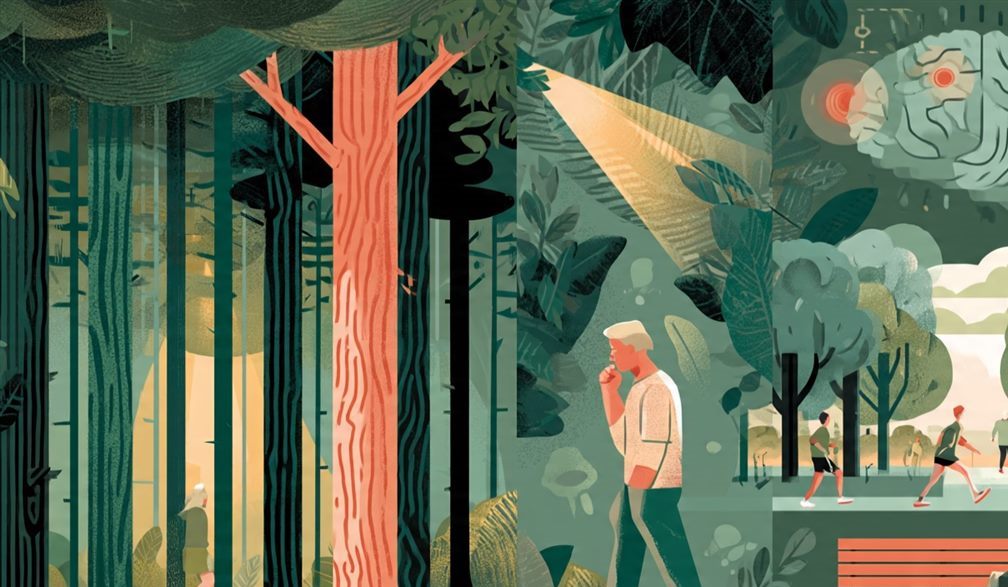
Human beings spent the vast majority of their evolutionary history in natural environments — forests, savannahs, rivers, coastlines. The transition to predominantly urban indoor living is, on evolutionary timescales, extremely recent. Research over the past two decades has produced a consistent finding: exposure to natural environments — green spaces, water, forests — produces measurable physiological and psychological benefits beyond what indoor environments or urbanscapes provide, even controlling for physical activity.
What the research shows
Cortisol and stress reduction
Multiple studies using salivary cortisol as a biomarker consistently show that spending time in forests or green spaces reduces cortisol levels compared to urban environments. A landmark study by Qing Li and colleagues in Japan (measuring NK cell activity, cortisol, and blood pressure during «forest bathing» — shinrin-yoku) found that 2-day forest immersion produced a 56% increase in NK cell activity (an immune measure), reduced cortisol, and lower blood pressure — with effects persisting for up to 30 days after the forest visit. Blood pressure and heart rate consistently show reductions in natural settings compared to urban environments in experimental studies with random assignment.

Attention restoration and cognitive replenishment
Rachel and Stephen Kaplan’s Attention Restoration Theory (ART) proposes a specific mechanism for nature’s cognitive benefits: natural environments capture what they term «involuntary attention» — soft fascination, the kind that holds interest without requiring directed effort (moving water, clouds, leaves, birds). This allows the directed attention system — heavily taxed by modern work, decision-making, and digital environments — to recover. Experimental studies find that walks in natural settings improve performance on attention and working memory tasks compared to equal-length walks in urban settings; viewing images of nature produces smaller but measurable attention recovery compared to urban images. Gregory Bratman and colleagues at Stanford found that a 90-minute walk in nature reduced neural activity in the subgenual prefrontal cortex — a brain region associated with rumination — compared to an urban walk.
Population health and green space access
Large-scale epidemiological studies support the mechanistic research. A systematic review of 900+ articles on green space and health found consistent associations between residential green space access and reduced cardiovascular mortality, lower rates of type 2 diabetes, reduced mental health morbidity, and lower all-cause mortality. The associations hold after adjusting for socioeconomic factors and physical activity — suggesting effects beyond simply providing a venue for exercise. The mechanisms proposed include: air quality (green spaces have lower particulate matter and noise pollution); temperature regulation (urban heat island effect); psychophysiological restoration (the cortisol and autonomic effects described above); social interaction (parks facilitate community contact); and physical activity facilitation. Studies in the UK National Health Service found that patients with greater green space access reported better mental health and had lower antidepressant prescription rates.
Practical implications: how much and what kind
The dose-response relationship between nature exposure and health is not perfectly characterized, but several threshold findings exist. A 2019 study by White et al. in Scientific Reports (survey of 20,000 people in England) found that spending at least 120 minutes per week in natural settings was associated with significantly better health and wellbeing — with no additional benefit beyond 200–300 minutes per week at population level. The 120-minute threshold could be accumulated in multiple shorter visits. The type of natural setting mattered less than the threshold being reached: urban parks, woodland, coastlines, and countryside all produced similar benefits. Forests and coastal environments showed slightly stronger effects in some studies, but the most accessible green space near you is more valuable than a distant «superior» environment that is visited rarely. Even brief exposures — 20 minutes in a park — produce measurable cortisol and mood improvements in experimental conditions.
Conclusion: 120 minutes per week is the evidence-supported target
The research on nature exposure is consistent enough to generate a practical recommendation: aim for 120 minutes per week in green or natural settings, which can be accumulated in any combination of visits. This is a low-cost, low-barrier, evidence-backed lifestyle practice with physiological effects (cortisol reduction, blood pressure, immune function) and cognitive effects (attention restoration, rumination reduction) that complement other health practices. The most accessible interpretation: a 20-minute walk in a park 6 days per week, or a longer weekend walk, achieves the threshold with minimal friction.