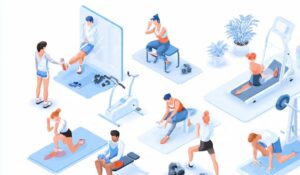

Most people who try to start exercising fail not because they lack willpower or fitness — they fail because they start too hard, too fast, and expect too much too soon. The beginner who goes from zero to six gym sessions per week in January is in pain by week two and back on the couch by February. The approach that actually builds a lasting exercise habit is less dramatic and significantly more effective: start smaller than feels necessary, progress gradually, and prioritize consistency over intensity. The goal in the first month is not transformation — it’s building the habit that makes transformation possible.
The foundational principles for beginners
Frequency beats duration. Three 20-minute sessions per week is more beneficial than one 60-minute session for building habit, recovering between sessions, and building aerobic adaptation. Frequency of the stimulus is what drives physiological change — especially for beginners, where significant adaptation occurs from relatively low stimulus. Progressive overload. The principle underlying all fitness improvement: systematically increasing the demand placed on the body over time. For beginners, this happens naturally — what was challenging in week one feels easier in week four, and the challenge is increased. Without progressive overload, the body adapts to the current stimulus and stops improving. Recovery is part of training. Adaptations (stronger muscles, better cardiovascular function, increased bone density) happen during recovery, not during exercise. Overtraining — more common in enthusiastic beginners than in experienced athletes — actually slows progress and increases injury risk.

What exercise actually means
The word «exercise» often conjures images of gyms, weights, and structured workouts. In practice, any sustained physical activity that elevates heart rate and challenges the musculoskeletal system counts. Walking — particularly brisk walking — is excellent cardiovascular exercise, genuinely beneficial for health, and the easiest possible starting point for sedentary beginners. A brisk 30-minute walk produces meaningful health benefits and is something almost everyone can do without equipment, gym membership, or athletic skill. If the jump from couch to formal exercise feels overwhelming, walking is the right starting point — not because it’s easy, but because it’s sustainable, and sustainable beats heroic.
Building a beginner exercise routine
Week 1-4: establishing the habit
The first four weeks should prioritize habit formation over performance. Three sessions per week, each 20-30 minutes. Choose activities with low barrier to entry: walking, cycling, swimming, bodyweight exercises at home, or basic gym machines. The content matters less than the consistency — what matters is that exercise becomes a fixed part of your weekly schedule. Attach it to an existing habit (going for a walk immediately after work, doing a bodyweight routine before breakfast) so it rides the momentum of an established behavior. Expect soreness after the first few sessions (Delayed Onset Muscle Soreness — DOMS — peaks 24-48 hours after unfamiliar exercise); this is normal and diminishes significantly as the body adapts over 2-3 weeks.
Adding structure: the three-modality framework
Optimal long-term fitness development requires three types of exercise: Cardiovascular/aerobic training — walking, running, cycling, swimming, rowing — for heart and lung health, metabolic efficiency, and longevity; Resistance/strength training — weight training, bodyweight exercises — for muscle mass, bone density, metabolic rate, and joint stability; Flexibility and mobility work — stretching, yoga, mobility drills — for joint range of motion and injury prevention. Beginners don’t need all three simultaneously — starting with one or two and adding the third after habit is established is more sustainable. But a complete long-term fitness program includes all three. After 4-6 weeks of consistent base exercise, begin incorporating the three modalities systematically.
Conclusion: small, consistent, progressive
The single most important principle for exercise beginners: start smaller than feels necessary and increase gradually. The biggest predictor of long-term fitness is not the intensity of any single workout — it’s how many years you consistently exercise. A moderate 30-minute walk three times a week, sustained over a decade, produces far better health outcomes than an intense 6-day program that lasts three months and is abandoned.
Find activities you at least don’t hate, schedule them at times that are realistic for your life, progress gradually when current sessions feel consistently manageable, and don’t let imperfect sessions derail the habit. The habit is the asset — everything else follows from that.