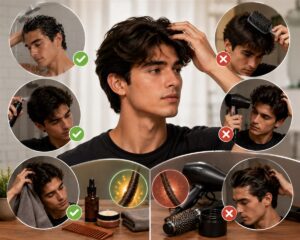
We spend roughly a third of our lives asleep — and during those 7-9 hours, hair is in constant contact with a pillowcase surface, subject to friction, compression, and moisture exchange that accumulates into significant cumulative damage over weeks and months. Most people never think about their hair while asleep, which is exactly why nighttime care is one of the most underutilized opportunities in hair maintenance. A few simple nighttime habits protect the hair you’ve worked to grow and condition, and some overnight treatments actively improve its condition while you sleep.
The pillowcase problem — and the solution
A standard cotton pillowcase creates significant friction against the hair shaft as you move during sleep — the cotton fibers catch the hair cuticle, roughing it up and causing frizz, split ends, and breakage over time. For curly and wavy hair, this nightly disruption is particularly damaging as it destroys curl definition and causes the tangling that leads to breakage during morning detangling.

Silk and satin: the single most impactful upgrade
Switching to a silk or satin pillowcase reduces hair friction dramatically because of the smooth surface texture — hair glides rather than catches. Both materials also absorb less moisture from the hair than cotton does. Pure mulberry silk (momme weight 19+) is the gold standard but expensive. Satin (typically polyester satin) is much more affordable and provides comparable friction-reduction benefits, though it doesn’t have the natural protein structure of silk that may offer additional hair benefits. Either option is meaningfully better than cotton for nightly hair protection. Satin-lined sleep caps or bonnets achieve the same protection and may be easier to maintain for people who move significantly during sleep.
Protective nighttime styles and overnight treatments
Protective styling for sleep
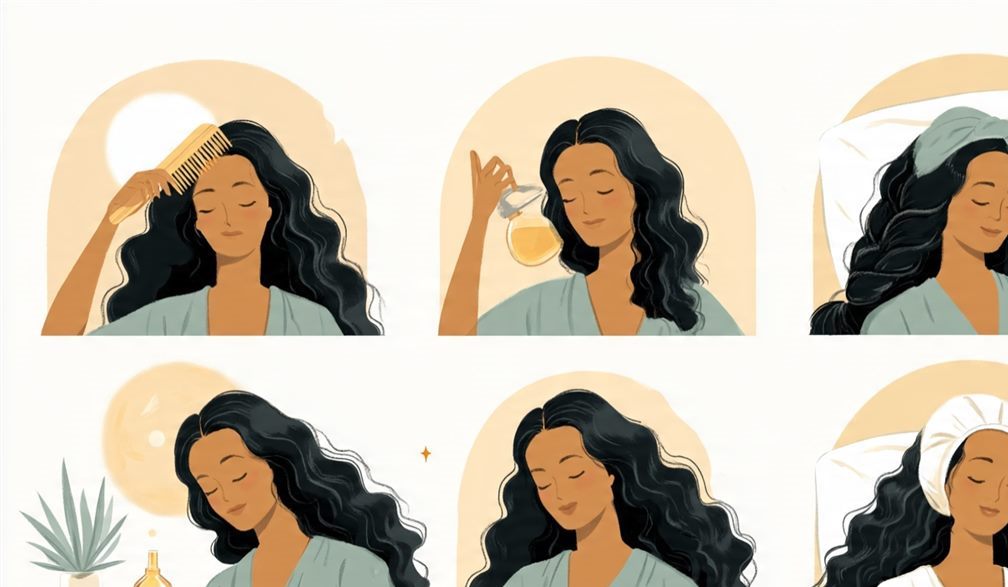
How you arrange hair before sleeping significantly affects how it looks and behaves in the morning and how much damage accumulates overnight. Loose braid or twist: pulls hair away from friction with pillow while maintaining some definition and preventing tangling. Particularly good for curly and wavy hair. Pineapple (loose high bun with a spiral/scrunchie): gathers hair upward and out of the way with minimal tension — the silk scrunchie prevents the crease that a regular elastic creates. Works well for medium to long hair. Loose bun with a spiral hair tie or scrunchie: similar benefits, good for any length above shoulder. Avoid: tight ponytails or elastics that create tension on the hairline and scalp; sleeping with hair loose and uncovered against cotton; and tight braids on wet hair (wet hair shrinks as it dries, creating tension if tightly braided).
Overnight treatments
Nighttime is an excellent window for intensive treatments that benefit from extended contact time. Overnight hair mask or oil treatment: applying a small amount of hair oil (argan, jojoba, or coconut for thick hair) or a leave-in conditioner to mid-lengths and ends before sleep allows extended absorption without the heaviness of a daytime application. Cover with a silk cap to avoid transfer to the pillow. Scalp oil treatment: a weekly pre-wash overnight scalp oiling (applying jojoba or diluted castor oil to the scalp, massaging for 5 minutes, then sleeping with a cap) deeply conditions the scalp before shampooing. Hair mask with heat: applying a deep conditioning mask before bed, covering with a plastic cap and a warm towel or using a heated cap, then rinsing in the morning provides an intensive conditioning treatment with ideal extended processing time.
Conclusion: nighttime is your hair’s best recovery window
A consistent nighttime hair care routine is one of the highest-return investments in hair health because it works passively — once the habits are established, the benefits accumulate every single night with minimal effort. The core protocol is simple: silk or satin pillowcase (or sleep cap), loose protective style, and a small amount of leave-in conditioning product on ends. Add an occasional overnight treatment mask for deeper conditioning, and a weekly scalp oil for scalp health.
After 4-6 weeks of consistent nighttime care, most people notice significantly reduced morning tangles, less frizz, and improved overall hair condition — effects that compound over time as the daily microabrasion that causes cumulative damage is consistently minimized.