
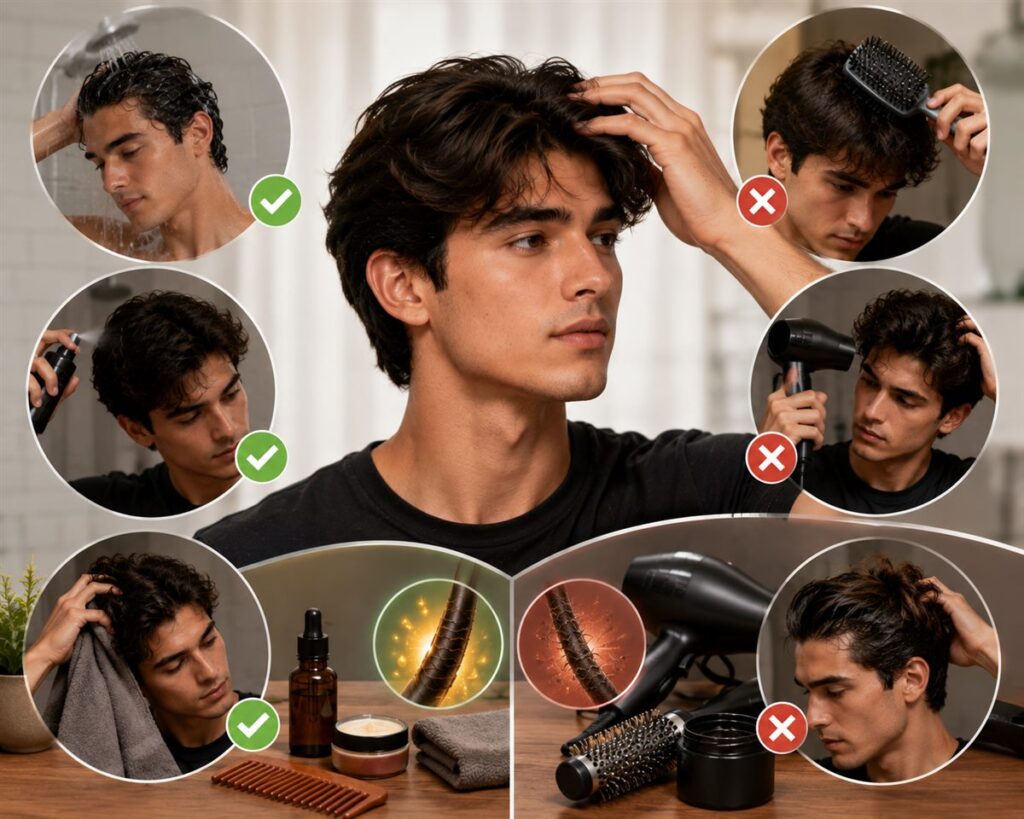
Daily styling is often the biggest source of cumulative hair damage — not because styling itself is inherently harmful, but because the habits most people develop over time are consistently hard on the hair shaft. Heat tools used on wet hair, brushing tangles from roots to ends, tying hair in tight elastics, rough towel-drying: each alone does small damage, but together and repeated daily, they add up to significantly degraded hair over months and years. The good news is that most of this damage is avoidable with simple technique adjustments that don’t require sacrificing your style.
Heat styling: the core rules
Heat is the most common source of styling damage, and the damage mechanism is well understood: temperatures above 150°C (300°F) begin degrading the keratin protein structure within the cortex; above 230°C (446°F), the damage is severe and rapid. Most flat irons reach 180-230°C and some reach 230°C by default — temperatures appropriate for thick, coarse hair but genuinely damaging for fine or already-fragile hair.

Temperature matching
Fine or already-damaged hair: 130-160°C (265-320°F). Medium hair: 160-185°C (320-365°F). Thick, coarse hair: 185-220°C (365-428°F). If you’re unsure, start lower and increase only if needed — effective styling at lower temperatures is always better than efficient styling at higher ones. Ionic and tourmaline plate tools heat more evenly and cause less scorching than basic ceramic; titanium plates conduct heat effectively but can easily damage fine hair because of their high thermal conductivity.
The heat protectant rule — no exceptions
A heat protectant is the single most effective protective measure for styled hair. Applied to damp or dry hair before any heat tool, it forms a thermal barrier that reduces the peak temperature the hair shaft experiences. Silicone-based protectants (dimethicone, cyclomethicone) provide the most consistent protection. Protein-based protectants (hydrolyzed keratin, silk amino acids) add a secondary benefit of filling surface damage. Never use a heat tool on product-free hair if you care about long-term condition.
Mechanical styling: technique matters as much as tools
How to brush without breaking
The most damaging brushing mistake is starting from the roots on tangled hair. Always detangle from ends upward — work through the bottom few inches first, then move higher as each section smooths. Use a wide-tooth comb or a detangling brush (with flexible bristles that bend rather than pull) on wet or damp hair. Never brush soaking wet hair with a paddle brush — wet hair is up to 60% more elastic than dry hair and will stretch and break rather than detangle smoothly.
Elastics and accessories
Tight elastic hairbands with metal clasps are particularly damaging — the metal creates a point of high friction that cuts into the cuticle and can snap strands. Fabric-covered elastics or spiral hair ties reduce friction significantly. Tight, high ponytails worn consistently create traction stress at the hairline that can cause traction alopecia over time — a form of hair loss caused by repeated mechanical tension. Loose styles, varied positions, and frequent changes of style direction are better for long-term hair health at the hairline and temples.
Conclusion: same style, less damage — it’s mostly technique
Achieving your preferred hair style while minimizing damage is largely a question of technique rather than giving anything up. Using heat tools at appropriate temperatures, always with a protectant, on properly prepared (not soaking wet) hair; detangling from ends upward; choosing low-friction accessories; and air-drying when possible — these habits collectively make an enormous difference to cumulative hair health without requiring you to change what your hair looks like.
The investment is small behavioral adjustments maintained consistently. Hair that is routinely treated gently grows out visibly healthier, holds styles better (healthy cuticles reflect product evenly), and requires less product to achieve the same results — a virtuous cycle that builds over time.


