
Nutrition labels are one of the most powerful tools for informed food choices — and one of the most frequently misread. Front-of-package marketing claims («natural,» «low-fat,» «high-protein,» «no added sugar») are largely unregulated and designed to sell, not to inform. The actual nutritional information panel (the standardized table of nutrients per serving) is regulated, consistent, and tells you what you actually need to know — if you know how to read it. This skill, once learned, applies to every packaged food you’ll encounter for the rest of your life.
The serving size trap
The most important — and most commonly misleading — element of any nutrition label is the serving size. All the nutrient numbers on the label refer to one serving, not to the entire package. A «serving» of chips may be listed as 28g (roughly a small handful), when the typical person eats the whole 150g bag. A «serving» of breakfast cereal is typically 30-40g — roughly a third of the bowl most people pour. Before looking at any other number, check the serving size and compare it honestly to how much you actually eat. If you eat three servings, multiply every number by three.
The numbers that matter most
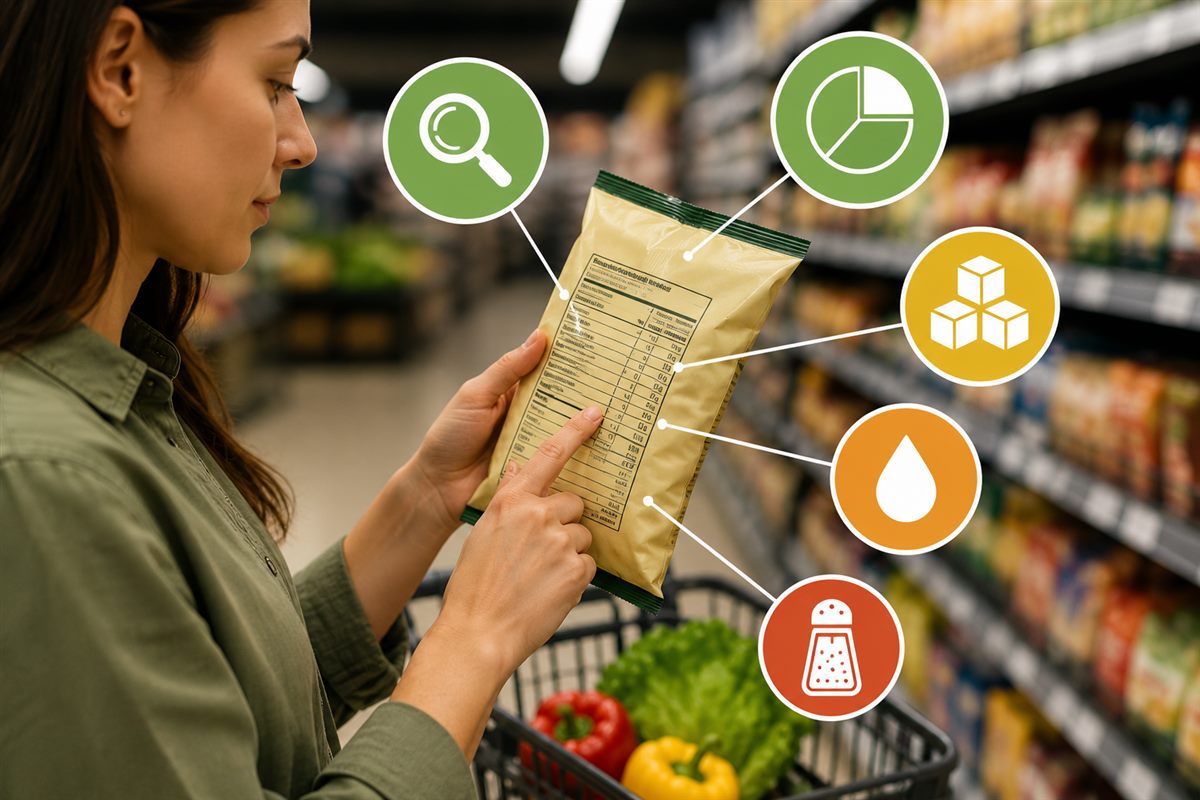
Calories: the total energy density per serving. Relevant for energy management but not a quality indicator — 100 calories from almonds and 100 calories from a cookie have very different nutritional effects. Protein: higher protein content per calorie is generally a quality indicator. Dietary fiber: one of the most important metrics for carbohydrate-containing foods — higher fiber indicates less processed carbohydrate source and better satiety and glycemic effect. Aim for ≥3g per serving for breads, cereals, and grains; ≥5g is excellent. Added sugars: distinct from total sugars on modern labels — this is the number to prioritize. Sodium: relevant for people monitoring cardiovascular risk or blood pressure — the upper recommendation is typically ≤2,300mg/day, and many processed foods contain a substantial portion of this in a single serving.
The ingredient list: the other essential half
Reading the ingredient list
The ingredient list is listed in descending order by weight — the first ingredient is the most abundant. This is often more revealing than the nutrition panel. If a product marketed as «whole grain» has enriched white flour as the first ingredient and whole wheat flour as the fourth, it is primarily a white flour product with some whole grain. If sugar (in any of its many names) appears multiple times in the first five ingredients, the product is high in added sugar regardless of whether the nutrition panel label seems moderate — manufacturers can use multiple sugar types to avoid having any single form appear prominently high in the list.
The NOVA classification shortcut
An increasingly used practical heuristic for food quality is the NOVA classification system, which categorizes foods by degree of processing rather than nutrient composition. The rule of thumb: if the ingredient list contains many items that aren’t recognizable as whole foods (emulsifiers, artificial flavors, color additives, texture agents, multiple types of sugar, isolated proteins), the product is likely ultra-processed — a category consistently associated with poor health outcomes in large cohort studies regardless of its specific nutrient profile. A short ingredient list of recognizable whole-food ingredients is generally a better indicator of food quality than any individual nutrient number.
Conclusion: serving size first, ingredient list second, numbers third
A practical label-reading hierarchy: first, check the serving size and adjust all numbers for how much you actually eat; second, scan the ingredient list for overall processing level and identify major ingredients and sugar sources; third, check fiber and protein content (quality indicators), added sugar, and sodium for products where these are relevant concerns. Front-of-package claims are marketing — ignore them and go straight to the standardized panel.
The ultimate goal is not to analyze every label obsessively, but to build enough literacy to quickly identify the products whose labels consistently reflect quality — and to recognize when a product’s front-of-package health claims don’t hold up to a 10-second glance at the actual nutrition facts.