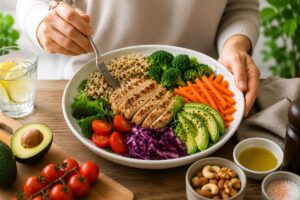

Protein is simultaneously the most studied macronutrient and the one about which there is the most ongoing debate about optimal intake. The official recommendation (0.8g/kg/day) is widely understood by nutrition researchers to reflect the minimum to prevent deficiency rather than the optimal for health, muscle maintenance, satiety, or longevity. Meanwhile, the fitness culture has pushed toward very high protein intakes (2-3g/kg or more) that exceed what the evidence supports as providing additional benefit. The actual optimal range — situated between these extremes — depends on your goals, activity level, and age.
Protein fundamentals: what it does and why it matters
Protein performs functions that cannot be replaced by carbohydrates or fat: it provides the amino acid building blocks for muscle (including the heart), enzymes (every metabolic reaction is catalyzed by protein enzymes), antibodies, hormones, and structural proteins. From a body composition perspective, protein is the most thermogenic macronutrient (costs roughly 20-30% of its calories to digest), the most satiating (reduces hunger more effectively than equivalent calories of fat or carbohydrate), and the most important nutrient for maintaining muscle mass during periods of weight loss.

The leucine threshold and meal distribution
Muscle protein synthesis (the process of building new muscle protein) is triggered by the amino acid leucine reaching a threshold concentration — approximately 2-3g per meal. Most protein sources contain adequate leucine if you’re consuming 20-40g of protein per meal; a protein-light meal of 10g may not trigger a full muscle protein synthesis response. This has practical implications for protein distribution: spreading protein intake across 3-4 meals (rather than consuming most protein in a single meal) maximizes the total muscle protein synthesis signal over the day. Eating 20-40g of protein at breakfast, lunch, and dinner is significantly more effective for muscle maintenance than eating 10g at breakfast and 80g at dinner.
Requirements by group and best sources
Requirements by life stage and activity
Sedentary adults: 0.8-1.0g/kg/day covers needs. Recreationally active adults: 1.2-1.6g/kg/day optimizes muscle maintenance and recovery. Strength training or endurance sports: 1.6-2.0g/kg/day supports muscle building and repair. Adults over 60: 1.2-1.6g/kg/day (higher end recommended) due to anabolic resistance — older muscle tissue requires more protein stimulus to achieve the same synthetic response as younger muscle. Weight loss: higher protein (1.6-2.0g/kg) during caloric restriction preserves lean muscle mass and improves body composition outcomes. Pregnancy: approximately 1.1g/kg/day (additional protein supports fetal growth, especially in the second and third trimesters).
Best protein sources
Animal proteins (eggs, chicken, fish, lean beef, dairy) contain all essential amino acids in appropriate ratios and are highly bioavailable. Soy, quinoa, buckwheat, and hempseed are the plant proteins with complete amino acid profiles. Other plant proteins (legumes, grains, nuts, seeds) are incomplete individually but provide complete profiles when combined over the course of a day. Prioritizing minimally processed protein sources over ultra-processed protein products (protein bars, protein powders) whenever practical provides better overall nutritional quality. Protein powders (whey, casein, pea, or rice protein) are a convenient supplement for people who genuinely struggle to meet protein needs through whole foods — they are useful tools rather than necessary components of a healthy diet.
Conclusion: aim for adequacy, distribute throughout the day
For most people, aiming for 1.2-1.6g/kg/day and distributing that protein across 3-4 meals covers the major evidence-based goals: muscle maintenance, satiety, and metabolic support. For active people in strength training, 1.6-2.0g/kg provides additional benefit for body composition. Very high intakes (above 2.5g/kg) in healthy adults do not appear harmful but also do not provide meaningful additional benefit over the 1.6-2.0g/kg range.
The practical starting point: include a palm-sized portion of protein (20-30g) at every meal — eggs, chicken, fish, legumes, Greek yogurt, cottage cheese, tofu — and you’ll likely be hitting an appropriate intake without needing to count grams.