
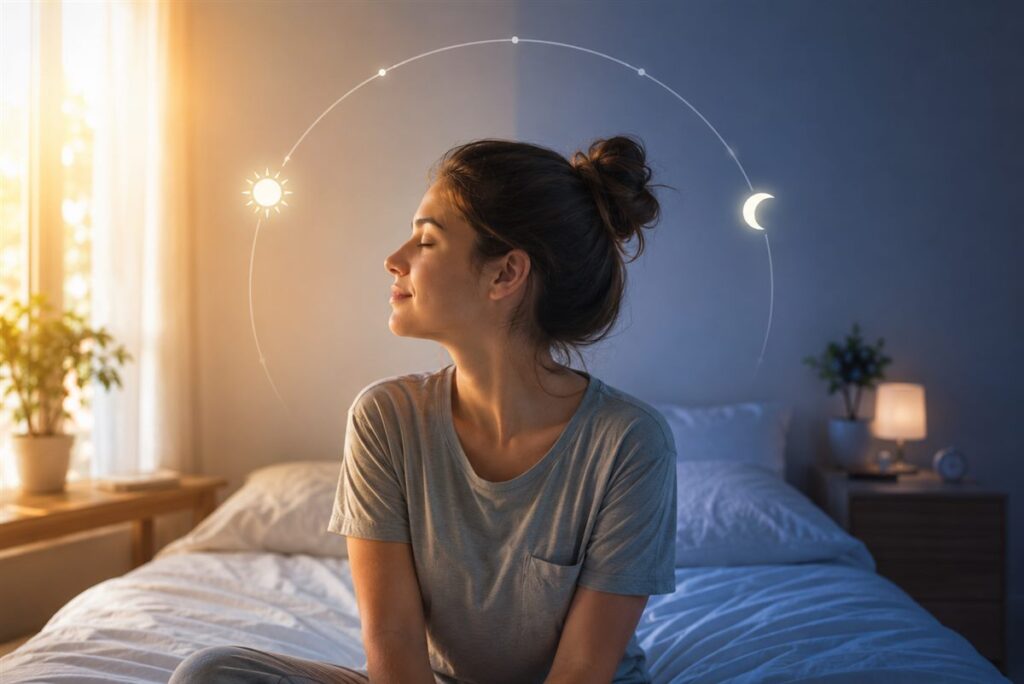
The 2017 Nobel Prize in Physiology or Medicine was awarded to Jeffrey Hall, Michael Rosbash, and Michael Young for discovering the molecular mechanisms controlling circadian rhythms — recognition of how fundamental this biological system is. The circadian clock is not just about sleep timing; it coordinates virtually every physiological process in the body to an approximately 24-hour cycle. Understanding how it works — and what disrupts it — changes the way you approach not just sleep, but eating, exercise, light exposure, and daily scheduling.
How the circadian clock works
The master clock resides in the suprachiasmatic nucleus (SCN) of the hypothalamus — a tiny structure of approximately 20,000 neurons that receives direct input from intrinsically photosensitive retinal ganglion cells (ipRGCs) containing the photopigment melanopsin. These cells are particularly sensitive to short-wavelength (blue) light and are the primary pathway through which light information entrains the circadian clock. The SCN coordinates peripheral clocks that exist in virtually every organ and tissue — including the liver, gut, heart, skin, and immune cells — through hormonal, neural, and temperature signals. The result: nearly every physiological parameter oscillates on a ~24-hour rhythm, including cortisol (peaks around 8am, lowest around midnight), body temperature (peaks late afternoon, lowest around 4am), melatonin (secretion begins 2-3 hours before habitual sleep onset, suppressed by light), immune activity, digestive enzyme secretion, and cell division rates.

Chronotypes: why some people are owls and others larks
Individual circadian phase — the timing of the clock relative to the external day — varies substantially between people. This is chronotype: morning types (larks) have an earlier phase with earlier sleep and wake times; evening types (owls) have a later phase. Chronotype is approximately 50% heritable (specific clock gene variants, particularly in PER3 and CLOCK genes, predict chronotype) and varies with age — adolescents show a significant phase delay (biological owlhood) that reverses in adulthood and advances again in older age. Social jet lag — the discrepancy between biological circadian phase and required social schedule — is extremely common: a genuine evening type forced to work early morning experiences it as chronic mild jet lag. This carries real health costs: people with large social jet lag have higher rates of metabolic disease, obesity, depression, and cardiovascular disease.
Circadian disruption and health consequences
Shift work, jet lag, and metabolic disease
The health consequences of circadian disruption are among the most consistent findings in chronobiology. Shift workers (particularly rotating and night-shift workers) have significantly elevated risks of metabolic syndrome, type 2 diabetes, cardiovascular disease, certain cancers (breast cancer — the IARC classified shift work as a Group 2A probable carcinogen in 2007), depression, and gastrointestinal disorders. The mechanism: circadian misalignment between the central clock (entrained by light) and peripheral clocks (entrained partly by food timing and activity) disrupts metabolic hormone secretion (insulin, leptin, ghrelin), immune function, and cellular repair processes that are exquisitely timed by the circadian system.
Practical circadian alignment strategies
To align daily habits with circadian biology: Bright morning light: outdoor light or a 10,000 lux light box within the first hour of waking — the most powerful circadian anchor. Avoid bright light after sunset: dim ambient lighting in the evening (below 10 lux is ideal) preserves melatonin onset; blue-light blocking glasses or display warm-tone settings help but are significantly less effective than reducing overall light intensity. Consistent meal timing: the peripheral clocks in digestive organs are entrained partly by food timing — eating at the same times each day, and avoiding eating in the 2-3 hours before sleep, supports metabolic circadian alignment. Time-restricted eating aligned with the daylight hours (eating window ending by 6-8pm) shows metabolic benefits in several studies. Exercise timing: morning and afternoon exercise is generally circadian-supportive; vigorous exercise within 2 hours of sleep may delay sleep onset in some people (though individual variation is high).
Conclusion: living in sync with your clock is a health practice
The circadian system is not a nicety — it is a fundamental organizing principle of mammalian biology that evolved over hundreds of millions of years to synchronize internal processes with the external environment. Modern life (artificial light, irregular schedules, night-shift work, transmeridian travel) creates unprecedented levels of circadian disruption, with measurable health consequences. Deliberately working with the circadian system — consistent light and dark timing, consistent sleep timing, meal timing alignment — is among the highest-leverage biological health practices available.
The three daily habits that most align the circadian clock: bright outdoor light within one hour of waking; dim light after sunset; and consistent wake time every day. Everything else builds from this foundation.