
Skincare product labels are deliberately designed to impress rather than inform. The front of the package promises radiant, plumped, firmed, renewed skin. The ingredient list on the back — the INCI list (International Nomenclature of Cosmetic Ingredients) — is where the actual formulation lives. Learning to read it gives you power: you can identify whether a product actually contains the actives it claims, at concentrations likely to be effective, and whether it contains ingredients your particular skin needs to avoid.
You don’t need to memorize hundreds of ingredient names. You need to understand the structure of the list and recognize a handful of key categories.
How the INCI list works
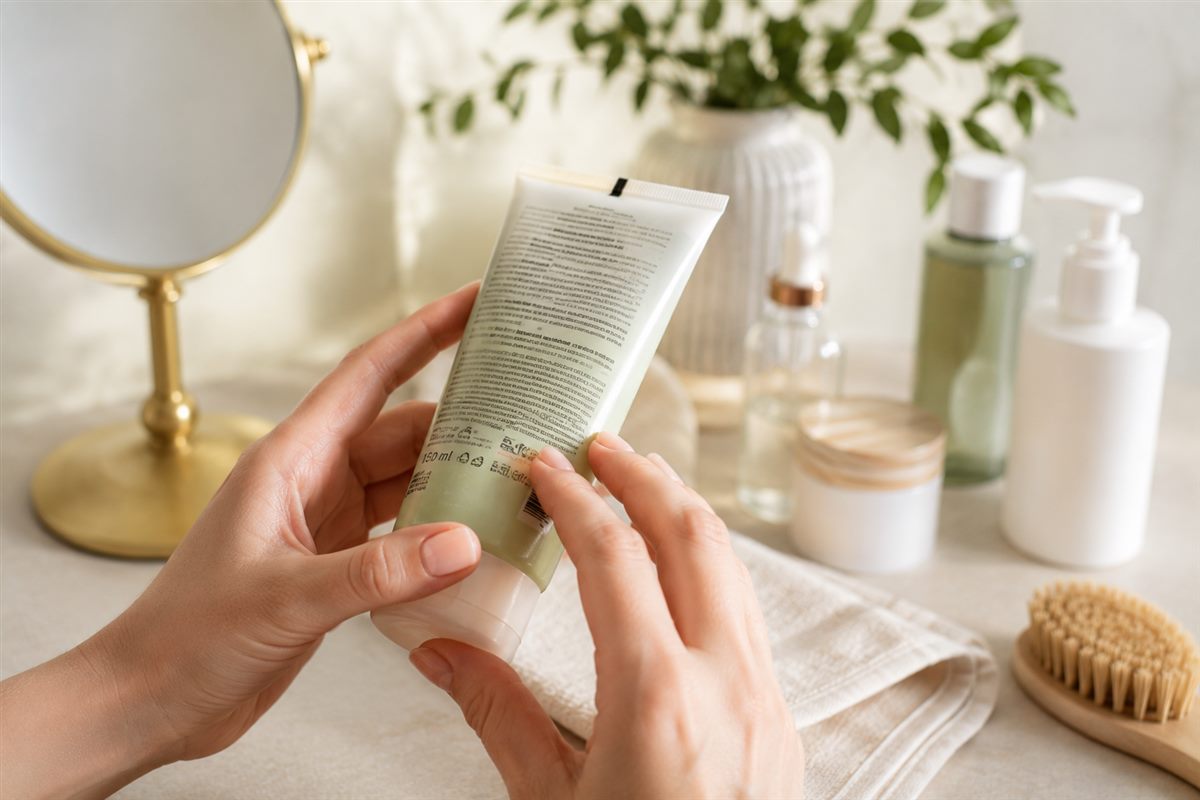
Cosmetic ingredient lists are written in descending order of concentration — the first ingredient is present in the highest amount, the last in the lowest. This structure is regulated in most countries. Understanding it immediately tells you several important things:
Where water falls tells you about the formula
Most skincare products begin with «Aqua» (water) — often comprising 60-80% of a typical moisturizer. The ingredients that follow in the first five or so positions form the bulk of the formula. This is where you find the base ingredients: emulsifiers, humectants like glycerin, thickeners. If your targeted active ingredient (say, retinol, or vitamin C as ascorbic acid) appears in the first 10 ingredients, it is likely at a meaningful concentration. If it appears near the end of a 30-ingredient list, it is present in trace amounts — often less than 1% — likely for marketing label purposes rather than functional effect.
The 1% rule
By convention, ingredients present at 1% or less can be listed in any order below the 1% threshold. This threshold is often (but not always) roughly marked by the appearance of preservatives (like phenoxyethanol, sodium benzoate, or ethylhexylglycerin) — these are typically used at 0.5-1%. Ingredients that appear after common preservatives are likely at concentrations below 1%. Many active ingredients (like peptides and some antioxidants) are effective at concentrations well below 1% — but others (like L-ascorbic acid at 10%+, or niacinamide at 2-5%) need to appear higher on the list to be functional.
Ingredients to recognize
Key hydrating ingredients
Glycerin (glycerol): the most widely used humectant, safe for all skin types, draws water to the skin surface. Sodium hyaluronate: the sodium salt of hyaluronic acid, smaller molecule than HA itself. Panthenol (pro-vitamin B5): both humectant and barrier-supportive, also soothing. Urea: humectant and keratolytic (exfoliating) at higher concentrations — excellent for very dry or rough skin. Ceramide NP / AP / EOP: essential barrier lipids; particularly valuable in cleansers and moisturizers for dry and sensitive skin.
Key actives to look for by position
Ascorbic acid / L-ascorbic acid: vitamin C; should be in first 10 ingredients in a vitamin C serum. Niacinamide: vitamin B3; effective at 2-5%, should be in top half of ingredient list. Retinol / retinyl palmitate / hydroxypinacolone retinoate: retinoids in cosmetic formulations. Adenosine: has evidence for anti-wrinkle effects; a common alternative to retinoids for sensitive skin. Alpha arbutin: brightening; typically at 1-2%. Salicylic acid: BHA exfoliant; effective at 0.5-2%.
Ingredients to watch for based on skin type
For sensitive and fragrance-reactive skin: scan for parfum / fragrance, linalool, limonene, geraniol, citral, eugenol, and essential oils (lavender oil, tea tree oil, citrus oils). These are the most common contact sensitizers in cosmetics. For acne-prone skin: some people react to isopropyl myristate, coconut oil (cocos nucifera), and heavy silicones (though silicone sensitivity in cosmetics is less common than often claimed online). Look for «non-comedogenic» formulations for moisturizers and sunscreens.
Conclusion: ingredient literacy is skincare literacy
You don’t need to become a cosmetic chemist to make better skincare decisions — you just need to know enough to evaluate what’s actually in a product versus what the marketing on the front says. The key questions when evaluating any skincare product: Is the claimed active ingredient present? Where does it fall on the list (suggesting its concentration)? Are there any ingredients my skin is known to react to? Is the price justified by the actual formula, or by the packaging and marketing?
Tools like INCIDecoder, CosDNA, and SkinSort allow you to search ingredient lists and get plain-English explanations of each ingredient’s function, concentration estimate, and safety profile. Using these tools for products you’re considering purchasing gives you information that advertising can’t provide — and often reveals that an affordable product has an identical or superior formula to a much more expensive one.