
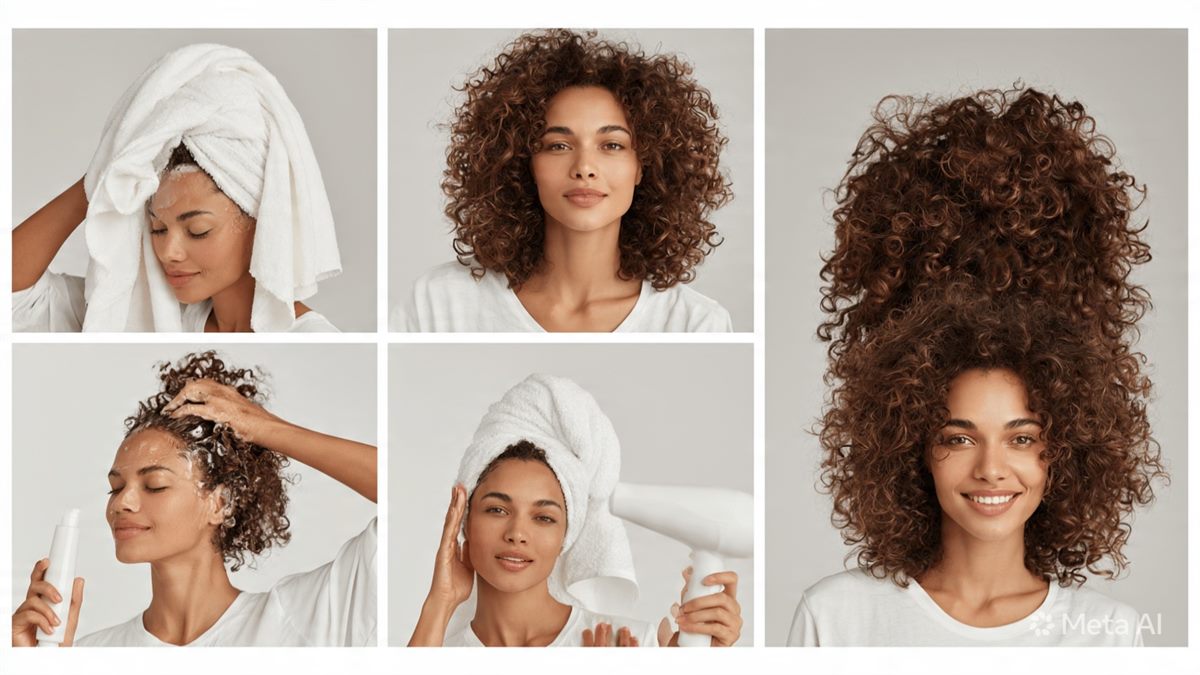
Curly and wavy hair has unique structural characteristics that make standard hair care advice — developed primarily for straighter hair types — actively counterproductive. The helical shape of curly hair makes it inherently drier (sebum from the scalp has difficulty traveling down a coiled shaft), more prone to mechanical damage (tangles multiply at every curl), and more porous (the coiled structure creates points of natural weakness in the cuticle). Understanding these characteristics explains why curly hair often thrives with a completely different approach to cleansing, conditioning, and styling.
Understanding curl patterns and porosity
Curl types are often classified on a numerical scale (2A-2C for wavy, 3A-3C for curly, 4A-4C for coily/kinky), but the more practically useful classification for product selection is porosity — the single most determining factor in how curly hair responds to moisture and product. Low-porosity curly hair resists moisture uptake and product penetration (products tend to sit on top); high-porosity curly hair absorbs moisture quickly but loses it just as fast (prone to frizz, tangling, and dryness).
Low-porosity curly hair
Low-porosity hair benefits from: heat application during conditioning (a warm cap or towel opens the cuticle to allow product penetration), lighter humectant-based products rather than heavy butters and oils (which sit on the surface and cause buildup), protein-free or low-protein formulas (protein can make already-stiff cuticles feel harder), and regular clarifying to remove product buildup that accumulates quickly on tightly sealed cuticles. Glycerin and aloe vera are excellent humectants for low-porosity hair.
High-porosity curly hair
High-porosity hair (often also chemically treated) benefits from: protein treatments to temporarily fill gaps in the cuticle, heavy emollient and occlusive products (shea butter, castor oil, coconut oil if it agrees with your hair) to seal moisture in, the LOC method (apply liquid first, then oil, then cream to lock in moisture sequentially), and cool water rinses to close the cuticle after washing. Leave-in conditioners are essential rather than optional for high-porosity curly hair.
The Curly Girl Method: a framework
The Curly Girl Method (CGM), developed by Lorraine Massey, has become the dominant framework for curly hair care globally. Its core principles: avoid sulfate shampoos (use co-washing or sulfate-free cleansers), avoid silicones that aren’t water-soluble (they build up without sulfate cleansers to remove them), avoid physical manipulation on dry curls (detangle only when wet and conditioned), scrunch and encourage curl formation rather than combing or brushing, and air-dry or diffuse rather than blow-drying with high heat on loose hair.
CGM is not universally appropriate — some people need sulfate cleansers to remove heavy products, some find co-washing doesn’t provide adequate cleansing for their scalp type, and some water-soluble silicones are genuinely beneficial. Treat CGM as a starting framework to be adapted to your specific hair’s response rather than as a rigid ruleset.
Conclusion: curly hair rewards patience and experimentation
Caring for curly hair effectively requires more customization than straight hair care — because the diversity within «curly hair» is enormous, and what works brilliantly for one curl pattern and porosity combination may not work at all for another. The key principles apply universally: prioritize moisture, reduce mechanical manipulation, protect from heat and environmental damage, and experiment systematically to find the specific combination of products and techniques that your particular hair responds to best.
Many people with curly hair who transition from straight-hair-focused routines to curl-appropriate care describe their hair as «completely transformed» — not because the hair changed, but because they finally gave it what it needs. Your curls were always there; the right approach lets them thrive.


